

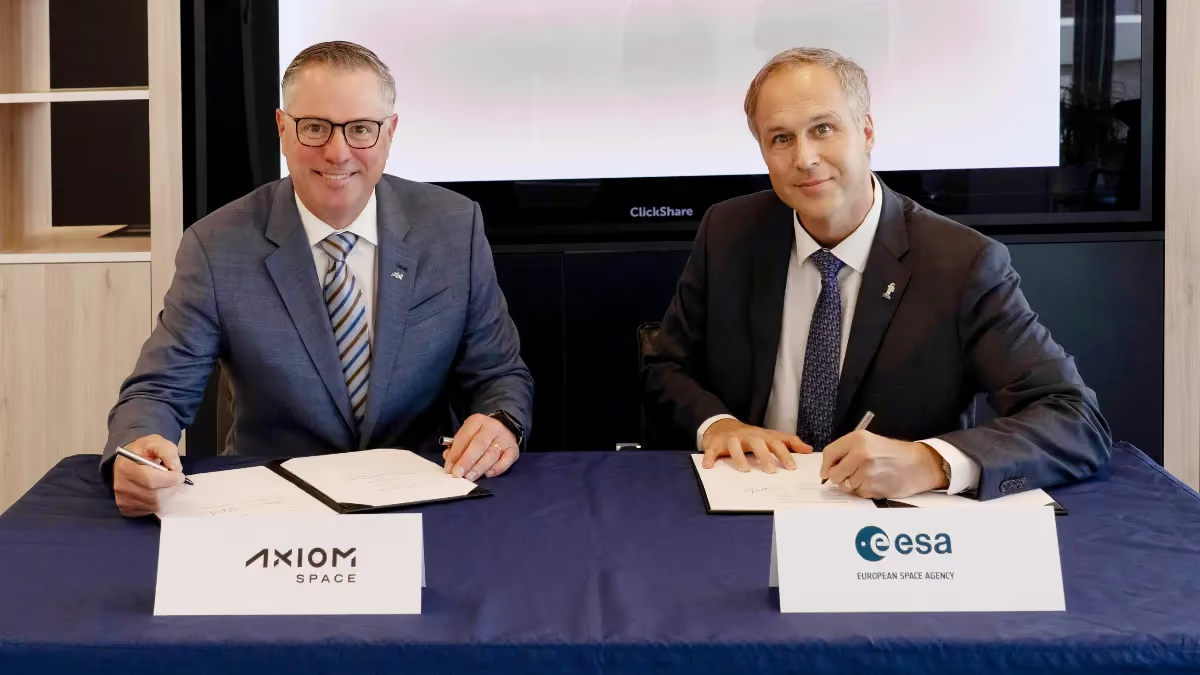
PARIS, Sept 10, 2026 – ÂÜÀòÊÓƵ and the signed a memorandum of understanding (MoU) at the European Space Agency (ESA) Headquarters in Paris, France.
The MoU emphasizes the importance of international collaboration and commercial innovation in space and seeks to broaden cooperation for sustained European access to low-Earth orbit (LEO), enabling an evolving space ecosystem.
 "The path to a sustainable human presence in space runs through international collaboration — reliable supply chains, shared innovation, and partners who bring real capability," said Dr. Jonathan Cirtain, CEO and President of ÂÜÀòÊÓƵ. "Europe's contributions to microgravity science and deep space technology make ESA exactly that kind of partner. This MoU strengthens our work together, and we look forward to ESA and its member states joining us as customers for future astronaut missions."
Together, the two organizations will explore cooperation on the development of space infrastructure, research, and commercial activities in LEO, including the potential for future astronaut missions onboard the International Space ÂÜÀòÊÓƵ (ISS) and Axiom ÂÜÀòÊÓƵ and the use of European Cargo Return service and potentially a European Crew Vehicle as part of the transportation system to support operations of the Axiom ÂÜÀòÊÓƵ.
“With the upcoming de-orbitation of the ISS, it is our duty to anticipate and prepare future solutions to ensure our access to low-Earth orbit,â€� said Daniel Neuenschwander, Director of Human and Robotic Exploration at ESA. “The two documents signed today underline both our commitment to safeguard our ability to pursue in-orbit science and to keep offering flight opportunities to our European astronaut corps, as well as the growing interest of international partners for our ongoing project to develop an autonomous European cargo vehicle.â€�Â
By leveraging ÂÜÀòÊÓƵ's University Alliance international network, ESA will have opportunities to contribute to and further European academic research and shape global research priorities. Â
The MoU includes potential cooperation on ÂÜÀòÊÓƵ’s spacesuits for orbital and lunar applications and opportunities to enhance the European Astronaut Centre’s capabilities for Extra Vehicular Activity (EVA) and lunar surface training using the Axiom Extravehicular Mobility Unit (AxEMU).Â
Together, ESA and ÂÜÀòÊÓƵ will identify opportunities to strengthen European research and industrial participation in the space ecosystem, activating new efforts for the region's industry base and ESA Member States.
About ÂÜÀòÊÓƵ
ÂÜÀòÊÓƵ is a human space exploration company, building era-defining space infrastructure and delivering technology-driven solutions that will empower civilization to transcend Earth. Beginning with , successor to the International Space ÂÜÀòÊÓƵ, the company is pioneering a next-generation orbital settlement that will foster groundbreaking innovation and research in microgravity and drive the global space economy of tomorrow. Today, guided by the vision of leading humanity's expansion off planet, ÂÜÀòÊÓƵ is the principal provider of commercial services and developer of for the Moon and beyond. For more information about ÂÜÀòÊÓƵ, visit . Â
Media Contact
media@axiomspace.com
�

Dr. Jonathan Cirtain
CEO and President, ÂÜÀòÊÓƵ
�

Daniel Neuenschwander
Director of Human and Robotic Exploration, ESA

.png)


.svg)